Brittney Poljacik receives a piece of Vermont Farmstead cheese from Marjorie Hardy (Milk Supply and Marketing Specialist) during our local cheese taste test on Wednesday.
Did you know that there is cheese being made approx. 4 miles from our school? Yes, in our backyard, directly up Church Hill, 7 different types of cheeses are being made at this local dairy. This company is all about local, from its start up days to present daily operations, it demonstrates LOCAL in every sense!
WES students taste tested a mild, buttery, soft cheese called Brick Haus Tilsit and they asked for seconds and thirds! It was a big hit and the cheese will most likely show up on our school menu again soon.
Marjorie did a great job of telling the students about the cows on the farm, how they live, how many times of day they are milked, how much milk they give and where the milk goes in order for it to get turned into cheese. Students asked great questions, however their favorite part was of course eating the cheese!
Thank you so much to The Vermont Farmstead Cheese company in supporting our taste test. We look forward to establishing a school-farm working relationship soon! Yipppeeee!
Students recording their cheese vote, "I Liked it!", "Sort of" or "No thank you!"
Austin Bloch gets some cheese!
Friday, March 16, 2012
Friday, February 24, 2012
Beets, Beets and more Beets!
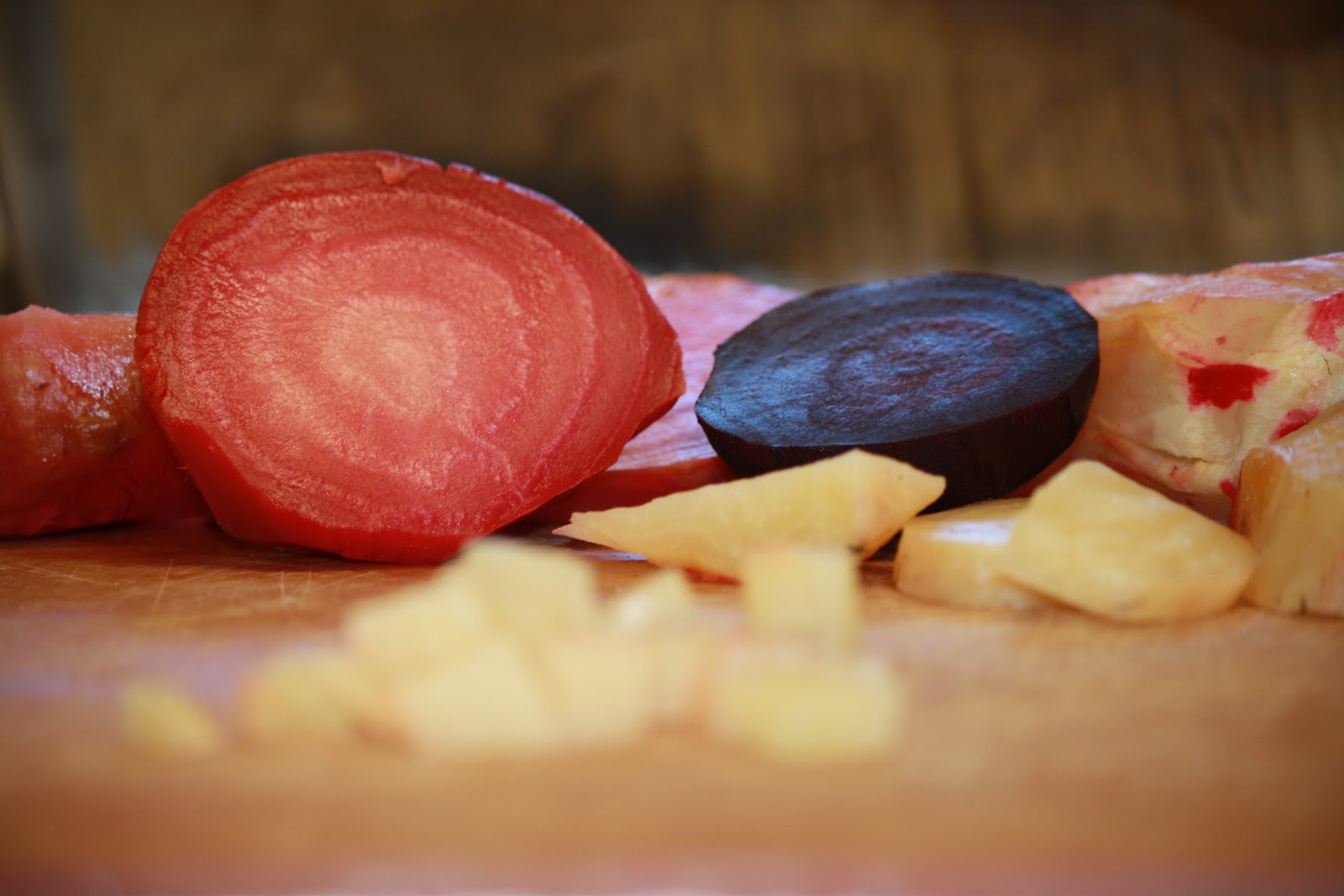
February 8th marked the completion of our second taste test. WES students and staff enjoyed beautiful beets from Pete's Greens, a 4-season organic farm located in Craftsbury, Vermont. (If you get a chance, please click on the link to view their website). What was so amazing about these beets were their colors! There were pinks, white and deep reds, which to me is a true sign of a whole food and the great nourishment they give our bodies! After roasting them for a long, long time in the ovens, we were able to peel the skin, dice them up and toss them with a little olive oil. The picture below shows our final product ready for taste testing.
Students and staff were very excited to learn that beets grow in such an array of colors. Our beet taste test chart showed most of the students "Liked" them, some were "Undecided" and a few said "No thank you!" The real test came the following two days when we offered the left over beets on the salad bar and they disappeared, even with such comments as "Yes, I love beets!"
We look forward to taste testing local cheese from the Vermont Farmstead, a local dairy farm in our backyard, up Churchill in South Woodstock. One of the farmers will be making a visit to talk about the cheese as well as help give out samples during our March 14th taste test! All parents are welcome. If you have any questions or would like help, please contact Gretchen Czaja (Healthy Foods Educator and Provider) gczaja@wcsu.net for more info!
Tuesday, January 17, 2012
Butternut Squash taste test kicks off the new year!
First graders Finn Davis and Trey Jones show off the beautiful color of the butternut squash during the taste test!
Last Wednesday 1/11, WES students in grades 1-6 participated in their first taste test of the new year! Taste tests are now scheduled on a regular basis in the WES cafe, and will be held the second Wednesday of every month. After students settled into the lunch time rhythm, they were able to sample a puree of butternut squash with optional toppings of maple syrup, raisins, sour cream or cheddar cheese. The toppings provided an added boost to the already great flavor of the squash, however it also demonstrated the combinations students could choose at home when eating their own squash. After they tasted it, they went up to chart paper on the wall and recorded their decision, "I liked it!" or "No thank you." The majority of the students decided it was something they REALLY liked and wanted it as an option on the lunch menu. There were a few students that really didn't like it, which were honest opinions and some that were on the fence. Either way it was a successful taste test and students learned what a healthy food butternut squash can be. Children's taste buds are consistently changing so it is important not to take offense when a child doesn't like a food item. It takes many samplings of something before they can really decide if they like something or not!
What is planned for our February taste test? Well, it is a deep red/purplish in color.....can you guess.....yes, BEETS! Stay tuned for more taste test findings!
Sunday, December 11, 2011
Support your local dairy!
We recently purchased a milk dispenser for our lunch and snack milk program. Last year students conducted research to find out how many cartons were being thrown away. On an average over 100 cartons were thrown in the trash a day and over a school year approx. 19,000 ended up in the landfill. The milk that was being purchased in these milk cartons (Hood) was also Massachusetts milk, not Vermont milk. Why are we buying milk from a another state? To make this change, WES applied for a food service grant and raised Farm to School funds to be able to purchase the dispenser and enough cups to use during lunch service and snack. The cups are 8 oz. BPA-free plastic and come in all different wonderful colors.
The students have been super excited about the change. Eli Grossman, a 6th grader says " It tastes less processed than the milk in the cartons." Another 6th grader, Brittney Poljacik says "It is colder, tastes fresher, and it is a double thumbs up. Now I buy milk everyday."
There is also a cost savings involved with buying milk in 5 gallon bags, it is cheaper than purchasing the cartons. The biggest benefit of all is that we are supporting Thomas Dairy, a local dairy in Rutland, VT because the bulk milk comes straight from the dairy!
If you have any questions or are interested in hearing about our milk dispenser, please contact Healthy Foods Educator and Provider,Gretchen Czaja gzaja@wcsu.net
The students have been super excited about the change. Eli Grossman, a 6th grader says " It tastes less processed than the milk in the cartons." Another 6th grader, Brittney Poljacik says "It is colder, tastes fresher, and it is a double thumbs up. Now I buy milk everyday."
There is also a cost savings involved with buying milk in 5 gallon bags, it is cheaper than purchasing the cartons. The biggest benefit of all is that we are supporting Thomas Dairy, a local dairy in Rutland, VT because the bulk milk comes straight from the dairy!
If you have any questions or are interested in hearing about our milk dispenser, please contact Healthy Foods Educator and Provider,Gretchen Czaja gzaja@wcsu.net
Saturday, November 26, 2011
WES Farm to School Lives!
A note from Ms. Czaja (Healthy Foods Educator and Provider)
Farm to School connects schools (K-12) and local farms with the objectives of serving healthy meals in school cafeterias, improving student nutrition, providing agriculture, health and nutrition education opportunities, and supporting local and regional farmers. (taken from: www.farmtoschool.org)
Yes, it has been a while, however the WES Farm to School (FTS) program is alive and well! Life cycles are everywhere and as our FTS program continues to cycle, it is morphing into something bigger and better! Through the years, we have dabbled in the different parts of FTS, however this is the year we begin to pull the three FTS C's (community, classroom and cafeteria) together for the first time. With the support of our school community, we will be able to really connect our children to their food and allow them to practice sustainable actions, EVERYDAY!
As the Healthy Foods Educator and Provider, I look forward to supporting our FTS program in ways which we have not yet explored. Providing healthy food experiences for our children on a daily basis will be one of my biggest goals, however creating learning opportunties in the gardens and cooking experiences will also be a priority!
Please subscribe to this blog! I will be updating it with our FTS progress as well as any cafeteria updates! Thank you for your support!
Farm to School connects schools (K-12) and local farms with the objectives of serving healthy meals in school cafeterias, improving student nutrition, providing agriculture, health and nutrition education opportunities, and supporting local and regional farmers. (taken from: www.farmtoschool.org)
Yes, it has been a while, however the WES Farm to School (FTS) program is alive and well! Life cycles are everywhere and as our FTS program continues to cycle, it is morphing into something bigger and better! Through the years, we have dabbled in the different parts of FTS, however this is the year we begin to pull the three FTS C's (community, classroom and cafeteria) together for the first time. With the support of our school community, we will be able to really connect our children to their food and allow them to practice sustainable actions, EVERYDAY!
As the Healthy Foods Educator and Provider, I look forward to supporting our FTS program in ways which we have not yet explored. Providing healthy food experiences for our children on a daily basis will be one of my biggest goals, however creating learning opportunties in the gardens and cooking experiences will also be a priority!
Please subscribe to this blog! I will be updating it with our FTS progress as well as any cafeteria updates! Thank you for your support!
Wednesday, June 8, 2011
Partnering with Sustainable Woodstock!
It takes community partnerships to support and enrich the lives of our children and last week here at WES was a perfect example of how partnerships begin. There are so many amazing organizations in our community and we are fortunate to have begun a new partnership with our friends from Sustainable Woodstock. With what began as a small discussion back in March with Anne Macksoud, is now a reality, planted in the form of 5 thorn less raspberry canes in our front gardens. Our 2nd and 3rd graders gathered outside to help David Doolittle plant donated raspberries canes (from his garden) in one of our new raised bed gardens. The students were very curious about these "magical plants" as David called them, and when they would be able to pick the raspberries. David talked about the canes, showed the students how to plant them, and how we would need to care for them. We were also joined by Sustainable Woodstock board members, Anne Macksoud and Joby Thompson. Thank you to Anne, David and Joby for making this yet another enriching experience in the lives of our children. We look forward to our new partnership together and the endless ways we can help each other!
WES students help David Doolittle plant raspberry canes, symbolizing the beginning of our new partnership!
Students gather for the raspberry planting!
CLICK HERE FOR INFORMATION ABOUT SUSTAINABLE WOODSTOCK
Thursday, June 2, 2011
3rd grade plants the Three Sisters Garden
Mr. Mumford shows a team of his and Mr.Souter's 3rd grade students how to build a soil mound so that they can plant the corn, beans, and squash in our Three Sisters Garden. The 3rd grade studied Native American history and how the Native Americans grew their own food. In the fall, the students will harvest the crops and have a harvest dinner.
Do you know what a Three Sisters Garden is? Here is one description taken from www.kidsgardening.com
Native peoples from different parts of North America have used a wide range of agricultural techniques. Perhaps the best known is the interplanting of corn, beans, and squash together a trio often referred to as the "three sisters." In a three sisters planting, the three partners benefit one another. Corn provides support for beans. Beans, like other legumes, have bacteria living on their roots that help them absorb nitrogen from the air and convert it to a form that plants can use. (Corn, which requires a lot of nitrogen to grow, benefits most.) The large, prickly squash leaves shade the soil, preventing weed growth, and deter animal pests. The three sisters also complement each other nutritionally.
Students get an overview of the Three Sisters Garden planting area.
Students work together in teams to plant each mound.
Subscribe to:
Posts (Atom)